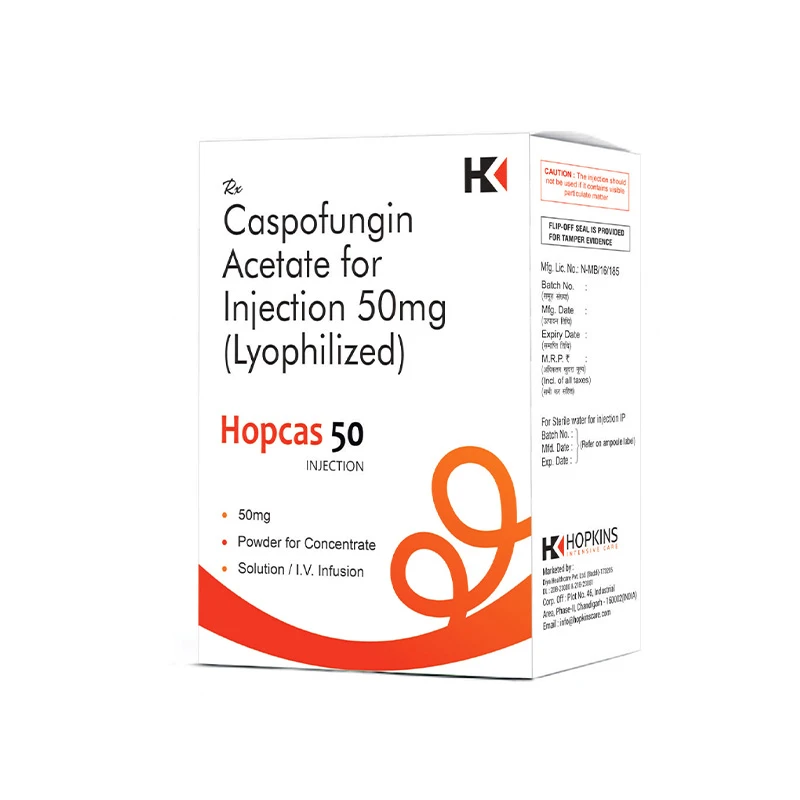
Hopcas 50 is an antifungal medicine containing Caspofungin 50 mg. It is a prescription injectable formulation from Diya Healthcare and is listed under its lyophilized product range. The product is supplied in a vial tray pack and is intended for administration by qualified healthcare professionals in appropriate clinical settings.
Composition
Each Hopcas 50 vial contains:
Caspofungin belongs to a class of antifungal medicines known as echinocandins. It works by inhibiting the formation of an essential component of the fungal cell wall, thereby helping to stop the growth of susceptible fungi. Unlike antibiotics, which target bacteria, caspofungin is specifically used against certain fungal infections.
Uses of Hopcas 50
Hopcas 50 may be prescribed for the treatment of certain serious or invasive fungal infections. Caspofungin is used in clinical practice for conditions such as invasive candidiasis, including candidemia, and invasive aspergillosis in patients who are not responding to or cannot tolerate other antifungal treatments. It may also be used as empirical antifungal therapy in certain patients with persistent fever and neutropenia, according to the treating physician’s assessment.
The exact indication, dosage and treatment duration depend on the type and severity of infection, the patient’s age, overall health, liver function and response to therapy. Hopcas 50 should therefore be administered strictly according to medical advice.
How Hopcas 50 Works?
Caspofungin works by inhibiting β-(1,3)-D-glucan synthesis, an important process involved in building the fungal cell wall. By interfering with this process, the medicine can weaken the fungal cell and contribute to its destruction or inhibition of growth. This mechanism makes caspofungin useful against several clinically important fungal pathogens.
Administration and Precautions
Hopcas 50 is an injectable medicine and should be administered by a trained healthcare professional. Patients should inform their doctor about any known drug allergies, liver problems, pregnancy, breastfeeding or other medicines they are taking.
Medical supervision is particularly important because antifungal therapy can cause adverse effects or interact with other medicines. Depending on the patient’s condition and treatment duration, healthcare professionals may monitor liver function and other relevant clinical parameters.
Do not self-administer Hopcas 50 or use it without a prescription. Antifungal treatment should be selected based on the suspected or confirmed fungal infection and the patient’s individual clinical requirements.
Frequently Asked Questions
1. What is Hopcas 50 used for?
Hopcas 50 contains caspofungin 50 mg and is used under medical supervision for certain serious fungal infections, including invasive candidiasis and selected cases of invasive aspergillosis.
2. What is the composition of Hopcas 50?
Hopcas 50 contains Caspofungin 50 mg as its active ingredient.
3. Is Hopcas 50 an antibiotic?
No. Hopcas 50 is an antifungal medicine, not an antibacterial antibiotic. Its active ingredient, caspofungin, belongs to the echinocandin class of antifungal medicines.
4. How is Hopcas 50 administered?
Hopcas 50 is an injectable formulation and should be administered by a qualified healthcare professional according to the prescribed dosage and clinical requirements.
5. Can Hopcas 50 be used without a prescription?
No. Hopcas 50 is a prescription medicine and should only be used under the supervision of a qualified healthcare professional.
6. What precautions should be taken with Hopcas 50?
Patients should inform their healthcare provider about allergies, liver problems, pregnancy or breastfeeding, and all medicines they are currently taking. Medical monitoring may be required during treatment.
7. Does Hopcas 50 treat all fungal infections?
No. Caspofungin is active against specific susceptible fungi and is prescribed according to the type of infection and the patient’s clinical condition. The treating physician determines whether it is appropriate.