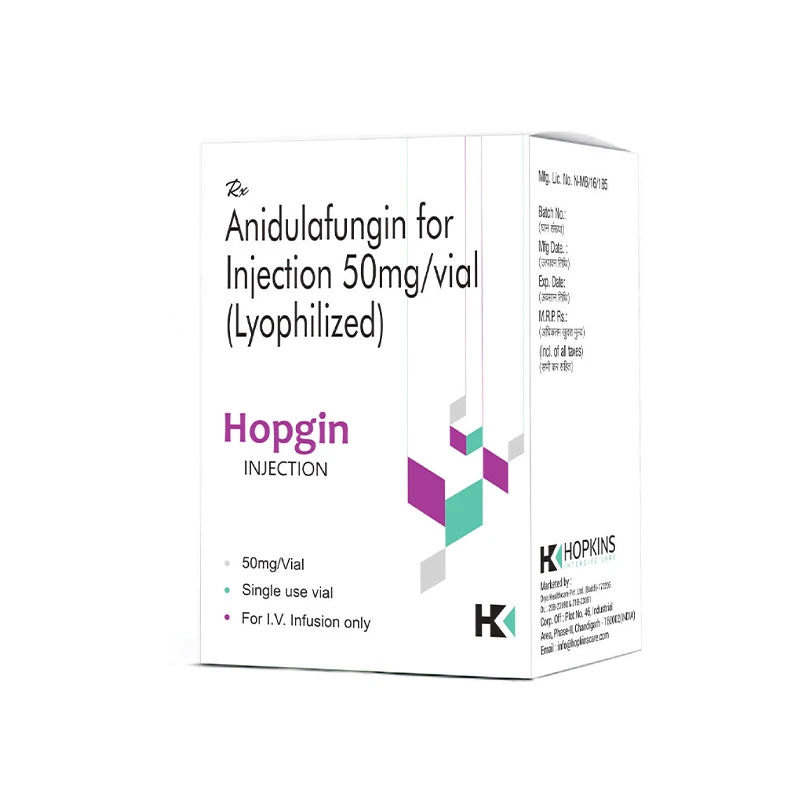
Hopgin 50
Anidulafungin 50 mg Injection
| Packing | Vial Tray Pack |
|---|
Hopgin 50 injection consists of Anidulafungin 50 mg which is an echinocandin antifungal medicine. It is used for the treatment of specific serious fungal infections caused by Candida species. It is supplied as an injectable formulation and is given intravenously by a certified healthcare professional. Anidulafungin operates by slowing down glucan synthase which is an enzyme needed for the formation of 1,3-beta-D-glucan which is an important ingredient of the fungal cell wall. This weakens the fungal cell wall and assists in controlling susceptible Candida infections.
Anidulafungin is used in situations like candidemia and other invasive Candida infections that includes certain intra abdominal abscesses and peritonitis. It is also indicated for esophageal candidiasis in adults. The proper strength and treatment regimen depend on the type and severity of infection and the patient’s clinical condition.
Hopgin 50 may be used as part of antifungal therapy for susceptible Candida infections. Depending on the clinical situation, anidulafungin may be prescribed for:
Before starting treatment, healthcare professionals may obtain fungal cultures and other relevant laboratory investigations to identify the causative organism and guide antifungal therapy.
Anidulafungin belongs to the echinocandin class of antifungal medicines. It inhibits glucan synthase, which fungi require to produce 1,3-beta-D-glucan. This substance is an important structural component of the fungal cell wall. By interfering with its production, anidulafungin compromises the fungal cell wall and helps inhibit the growth of susceptible fungi.
Hopgin 50 should be administered only by intravenous infusion under medical supervision. The dose is selected according to the infection being treated. For adult esophageal candidiasis, the approved anidulafungin regimen is a 100 mg loading dose on Day 1 followed by 50 mg once daily. For candidemia and other invasive Candida infections in adults, the recommended regimen is different and generally uses a 200 mg loading dose followed by 100 mg once daily. Therefore, the 50 mg strength should not be interpreted as the appropriate dose for every type of Candida infection.
The injection must be appropriately reconstituted and diluted before administration according to the product’s approved instructions. The infusion rate should not exceed the recommended limit because rapid infusion may increase the risk of infusion-related reactions.
Possible adverse effects associated with anidulafungin may include:
Serious hypersensitivity reactions, including anaphylaxis, have also been reported. Symptoms such as rash, flushing, itching, breathing difficulty, bronchospasm or low blood pressure require immediate medical attention. Liver function may also need to be monitored during treatment.
Hopgin 50 should be used under the supervision of a healthcare professional. Patients should inform their doctor about any previous allergy to anidulafungin or other echinocandin antifungals. Anidulafungin products containing fructose should not be used in patients with known or suspected hereditary fructose intolerance.
Patients should also inform their healthcare provider about pregnancy, breastfeeding, liver problems, allergies and any medicines they are currently taking before treatment begins.
Hopgin 50 contains Anidulafungin 50 mg and may be used to treat certain Candida infections. Anidulafungin is indicated for candidemia and certain other Candida infections, as well as esophageal candidiasis in adults.
Hopgin 50 Injection contains Anidulafungin 50 mg as its active pharmaceutical ingredient.
No. Hopgin 50 is an antifungal medicine belonging to the echinocandin class. It is used to treat susceptible fungal infections rather than bacterial infections.
Hopgin 50 is administered by intravenous infusion after appropriate preparation. It should be given by trained healthcare personnel and should not be self-administered.
No. The dosage and duration depend on the specific infection. For example, 50 mg once daily is an approved maintenance regimen for adult esophageal candidiasis, whereas candidemia and other invasive Candida infections generally require a higher maintenance dose after a loading dose.
Possible side effects include nausea, vomiting, diarrhoea, headache, fever, abnormal liver tests and infusion-related reactions.
Pregnant patients should inform their doctor before receiving Anidulafungin. The healthcare professional will assess the potential benefits and risks before recommending treatment.
People with a known hypersensitivity to anidulafungin, other echinocandins or any component of the formulation should not receive it. Products containing fructose are also contraindicated in patients with known or suspected hereditary fructose intolerance.

+91 98557 72237
+91 94646 49052
info@diyahealthcare.com
Plot No. 46, Near Passport Office Industrial Area, Phase 2 Chandigarh – 160002